
|
http://Link2me.com
Link2Me Link Exchange Directory - The Best Link Exchange for
SEO Professionals
Quality directory of webmasters actively seeking link
exchange. Improve your search engine rankings and link popularity the easy way.
Work clever not hard.
ESL Job
Spot ESL Teaching Jobs in Asia Job Board
Authentic Discount Sunglasses. Designer Glasses Online.
Prada, Chopard, Marc Jacobs, Tom Ford, Adidas
Draw attention to really inexpensive authentic discount
designer sunglasses and eyewear online such as Chanel,
Chopard, Christian Dior, Dolce Gabbana, Gattinoni, Gianni
Versace, Giorgio Armani, Gucci, Prada, Revo...
Tigerjobs.com jobs Free job Bank for job seekers in
sales, customer service and business careers.
Surfcash Traffic
Exchange SurfCash Is A Unique System For Site Owners
Wanting High Exposure. We have combined a Traffic Exchange,
Banner Exchange and a Text Ad Exchange, all on the same
credit system.
THESIS INTRODUCTION
1
Introduction
1.1
Introduction to Composites
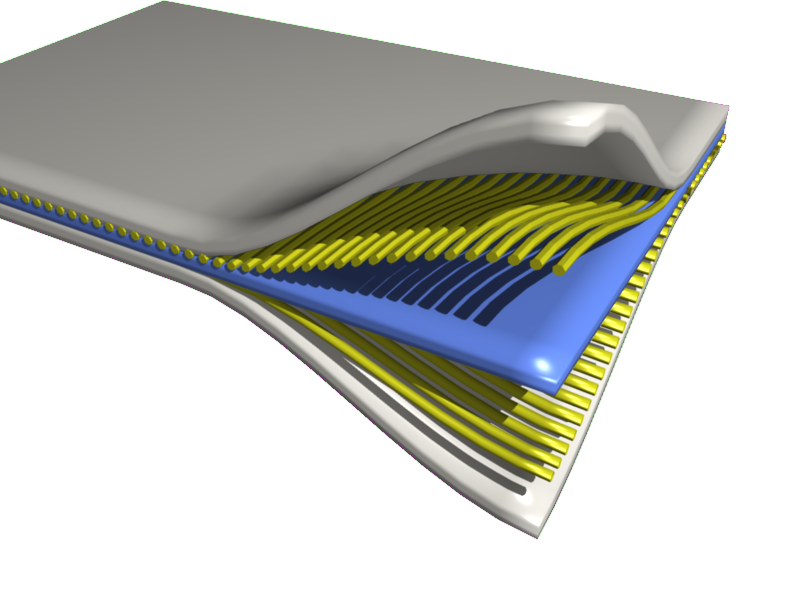
The construction of composite materials has had a long and
extensive history dating back thousands of years. By intuitively combining
different materials a new, enhanced material that exhibits characteristics of
the mixed constituents can be produced. In general, ‘composites’ refers
to the combination of two or more materials; but, more specifically, the word ‘composites’
refers to (or is often associated with) a combination of highly engineered
resins and reinforcing materials.
More than most disciplines of engineering, aerospace designs are
rigorously optimized for weight. With this in mind, the industry has been drawn
towards the attractive characteristics of composite materials. Composites
provide many advantages over homogenous materials, some of which are found in
their mechanical properties, such as weight, strength, stiffness, corrosion
resistance and fatigue life.
Composites are widely used in control surfaces such as ailerons,
flaps, stabilizers, rudders, as well as rotary props and fixed wings. These
fibrous composites can provide a high strength for control
surfaces at a fraction of the weight of homogeneous metallics. The versatility
in the design of fibrous composites is especially important. The
stiffness of a particular composite beam, for example, can be altered in design
by simply adjusting the fiber orientation and stacking sequence.
Aeroelastic flutter is one of the most critical safety concerns
in aerospace designs. The design and optimization of wing structures requires a
strong emphasis on aeroelastic tailoring, so the predicted instabilities can be
avoided. Aeroelasticity, the study of the mutual interaction between fluid flow
and structure, embraces various disciplines, including aerodynamics, solid
mechanics and vibrations.
Many different types of flutter exist: namely bending torsion
flutter, binary flutter, stall flutter, panel flutter and single degree of
freedom flutter. The current research is focused on bending-torsion flutter,
other types of flutter may be considered for future endeavours, however, they
will not be this studied in this paper.
Coalescence-type flutter is another type of flutter that occurs
when the bending and twisting
frequencies merge at a specific dynamic pressure. This is generally observed to
occur when aerodynamic damping is omitted. There is a distinct difference in the
coalescence flutter between homogeneous wings and composite wings. Coalescence
flutter of homogeneous wings composed normally of metal, usually occurs with the
merging of the first two fundamental frequencies (Hashemi and Alighanbari,
2002). By contrast, in composite wings this merging of frequencies between
bending and twisting modes generally occurs at higher frequencies.
Generally a wing can undergo bending, torsion and coupled
bending-torsion displacements if there is an offset of the mass axis (CG) from
the elastic axis (EA). For composite wings, a material coupling exists due to
the anisotropy of composite material. A bending-torsion material coupling is
created from symmetric laminates or, in the case of thin-walled box-wing
structures, Circumferentially Asymmetric Stiffness (CAS) configurations
(Armanios
et al, 1995). This coupling between bending and torsion, whether it
derives from the physical geometry of the wing or as a result of material
coupling, can lead to the flutter phenomenon. Bending-torsion flutter is a
pitch-plunge instability generated at a specific applied dynamic pressure.
The accuracy of an aeroelastic flutter or divergence analysis
depends greatly on the reliability of the free vibration analysis used to
describe the natural modes of the system. There are various well-established
methods to formulate and extract these natural frequencies, namely, Finite
Elements (FE), Dynamic Stiffness Matrix (DSM) and Dynamic Finite Elements (DFE).
Finite Elements has a long, well established history and is the
most commonly used numerical method for analyzing structures. Finite Elements is
the most general and systematic approach to formulate the element, mass and
stiffness matrices for a given system and it is easily adaptable to complex
systems involving variations in geometry or loading. The use of fixed polynomial
shape (interpolation) functions leads to constant mass and stiffness matrices,
and the natural frequencies can be readily found by solving the resulting linear
eigenvalue problem. The Finite Element method has been widely used by Teh and
Huang, 1979; Chandra et al, 1990; Wu and Sun, 1991; Jaehong and Kim,
2002; for the analysis of beam-type structures.
Finite elements are also commonly used in commercial software
packages such as ANSYS® and ABAQUS®. In the last decade, composite elements have
been available in these software packages and used by a number of authors to
analyze the vibration of composite wings.
Alternatively to Finite elements, the Dynamic Stiffness Matrix
(DSM) method can be employed to evaluate the natural frequencies and modes of a
structure. The DSM was first developed by Kolousek in 1940 for homogeneous
Euler-Bernoulli beams and later extended to a number of structural elements by
other researchers. In fact, the DSM has since been refined continuously. In the
last decade, Banerjee and his colleagues have published a large number of papers
pertaining to the vibration analysis of many different homogeneous and composite
beam models. Banerjee and Williams (1995) developed the DSM for a uniform
Euler-Bernoulli beam, Banerjee and Williams (1996) extended that to the
Timoshenko beam theory and then later this model was further extended to include
an axial force (Banerjee, 1998). Based on the exact member theory, the DSM
produces exact natural frequencies for a uniform beam element using generally
only one element.
Other analytical, semi-analytical, numerical and hybrid methods
have also been researched. Based in part, on the DSM, the Dynamic Finite Element
(DFE) method is a hybrid ‘dynamic’ numerical method. Dynamic refers to the
frequency dependency of the trigonometric shape functions used to approximate
the stiffness matrix of a beam-type system. The other building block of this
hybrid method is based on Finite Elements, by providing a general systematic
procedure (i.e., Integral Formulation based on the Weighted Residual Method
(WRM)). The DFE technique follows the same typical procedure as the Finite
elements by formulating the element equations discretized to a local (element)
domain, where element stiffness matrices are constructed and assembled into a
single global matrix. As a result, the DFE can be easily extended to elements
with a higher degree of complexity.
The Dynamic Finite Element (DFE) formulation was first proposed by
Hashemi (1996) and has since been well established for the free
vibration analysis of homogeneous beams, blades and beam-like structures
(Hashemi et al,1997; Hashemi, 1998; Hashemi and Richard, 1999; Hashemi, 2002).
The DFE has been shown to converge faster to the exact natural frequencies than
both the FE and DSM when such higher complexities as tapered geometries are
involved (Borneman, 2004; Hashemi and Borneman, 2005). The DFE has the advantage
of incorporating added terms known as ‘refining terms’ or more commonly called
‘deviators terms’ to enhance or refine the stiffness matrix. This consequently
results in much more accurate natural frequencies of the analyzed structure.
This enhanced stiffness matrix is sometimes referred to as Refined Dynamic
Finite Elements (RDFE). The DFE is validated by its faster convergence to
the natural frequencies than other existing methods (Borneman and Hashemi, 2003;
Hashemi and Borneman, 2003; Hashemi and Borneman, 2004).
The free vibration analysis of composite beam-type structures is
well established using various techniques. There are also a number of
publications that extend this study to incorporate damages such as
delamination, fiber matrix cracking, de-bonding
between matrix and fibers or fatigue damage into a free vibration analysis.
The analysis of cracked beams has been conducted by a number of
authors, including Mujumdar and Suryanarayan (1988), where an analytical model
for the free vibration analysis is developed for beams with delamination. Later
Shen and Pierre (1994) conducted the free vibration analysis of a homogenous
cracked Euler-Bernoulli beam using Galerkin and Rayleigh-Ritz methods. The
illustrated mode plots show distinct slope changes at the crack location.
Cracked fibrous composites have been studied by numerous authors in the
past decade.
Boa (1992) developed a function to correct the stress intensity
factors which describe the energy release rate of a cracked composite beam
initially developed by Tada et al (2000), to take into account the anisotropy of
composite material. He found that this function produced consistent results for
4 different cracked-typed specimens. Ghoneam (1995) studied the vibration
characteristics of an open cracked composite beam with various end boundaries,
(C-C, C-F, C-S, S-S) but didn’t account for material anisotropy in the stress
intensity factors. Krawczuk published a number of papers involving the vibration
characteristics of damaged beams. Krawczuk (1994) observed that the natural
frequencies are highest when the composite fibers are perpendicular to the
crack. Krawczuk et al (1995) studied the modes of damaged beams
containing different crack depths and positions as well as the influence of
fiber volume fraction. It is observed that for low fiber angles the influence of
fiber volume fraction is of great significance. Krawczuk et al (1997)
extended this vibration analysis to include damages such as delaminations. Kisa
et al (1998) developed a free vibration model for damaged composite beams
using finite elements and extended it to include Timoshenko beam assumptions.
More recently a paper was published by Zheng and Kessissoglou
(2003) who proposed a new approach to formulating a cracked beam by using a
‘total flexibility’ approach instead of the local flexibility used previously.
The development of new interpolation functions were designed specifically for
this cracked member. By using this total flexibility technique the extracted
frequencies tend to be more accurate.
Also Nayfeh and Abdelrahman (2003) developed a new
micromechanical model to study a damaged composite beam that can be adapted for
beams with a single fiber crack, single matrix crack, or multiple damage
scenarios.
Wang et al (2005) used the Dynamic Stiffness Matrix (DSM)
method to model a through thickness cracked beam. The DSM provides accurate
modes for a bending-torsion coupled uniform composite beam using a relatively
coarse mesh, compared to the other methods. Wang (2004) had also studied how a
through thickness crack will change the free vibration modes and aeroelastic
flutter and divergence of a composite wing. A method was devised to detect a
crack in a wing using Cawley-Adams Criterion (CAC) by a different ordering of
modes.
A method to detect small cracks in a metal or homogeneous
material in a non-destructive way by means of natural frequencies was first
proposed by Adams et al (1978). He proposed that the crack size and
location on a bar specimen could be found using natural frequencies of free
vibration ignoring the natural modes all together.
Non-Destructive Testing (NDT) is normally used for the detection
of defects in structures, for example an aircraft wing. Liquid penetrate,
magnetic particles, radiography and eddy current techniques usually require long
periods of time to localize and access the damage of the structures.
Alternatively, a technique exists, often referred to as Structural Health
Monitoring (SHM), which has been growing in attention in recent years. As being
a subsidiary of NDT, SHM provides the same non-destructive testing but without
the offline inspections normally required by NDT. With a number of sensors
imbedded into a structure such as a wing, the wing can be monitored continuously
for defects without offline inspection.
This type of detection is advantageous for cost saving, but also
for early detection of possible critical defects. For example, a wing with a
crack in flight could be detected immediately using SHM, whereas, the crack
could go unnoticed for a period of time before being detected using classical
NDT techniques.
The focus of this research is geared towards the vibrational
behaviour, aeroelasticity and detection of damaged composite wings. The free
vibration modes are evaluated using Dynamic Finite Elements (DFE), Finite
Elements (FE) and Dynamic Stiffness Matrix (DSM). The wing damage is considered
as a through thickness edge crack for all proposed formulations and numerical
tests.
Wang (2004) used a Dynamic Stiffness Matrix (DSM), which is well
suited for this analysis as it provides exact fundamental natural frequencies
for a uniform wing. The motivation of implementing the DFE methodology in this
research is that the technique has shown to generally have higher accuracy and
convergence rates in the calculated natural frequencies and modes of beam
structures, when compared to other existing methods and more specifically for
cases with a higher degree of complexity (e.g., tapered wings). The DFE has
proven to be an excellent preliminary tool in the free vibration analysis of
homogeneous metallic and composite beam and blades (Hashemi, 1998; Borneman,
2004).
The following contributions are new concepts and strategies for
the analysis of cracked composite wings:
1)
The development of various formulations is
accomplished for the free vibration of wings with specific geometry and loading,
and,
2)
A new strategy is devised and tested for detection
of single and multiple cracks with an accurate method to capture the natural
frequencies of a defective wing.
The Dynamic Finite Element (DFE) method is well established. It
is also known to produce accurate free vibration frequencies and modes for
various structures. The development of a new DFCE is accomplished and
numerically tested for various laminated composite defective wing
configurations. The motivation for constructing a DFCE is based on the enhanced
convergence and accuracy of the technique. Dynamic Finite Elements (DFE) have
been shown to provide excellent accuracy involving the calculations and
convergence of the natural frequencies for homogeneous and laminated fibrous
composite beam and wing structures. This dynamic element can be applied readily
to models that consist of variations in geometry or loading, implementing
refined terms to improve the convergence of the calculated frequencies. A DFCE
provides the necessary precision in the natural frequencies with the intention
that it will be used in a free vibratory detection methodology.
A Dynamic Stiffness Matrix for a cracked composite beam element
using Euler-Bernoulli beam bending and St. Venant torsion is well established by
Wang (2004). A natural extension to this development would be to investigate
thicker beams where shear deformation must be acknowledged. The free vibration
of slender beams is well established using finite elements. Shear deformation is
avoided by many researchers that rely on finite elements due to the shear
locking phenomenon. A Dynamic Stiffness Matrix formulated by Banerjee (1998) for
composite intact Timoshenko beams does not fail from shear locking. It
provides generally the exact natural frequencies for a uniform beam. The
development of a cracked beam model including shear deformation is well
established for homogeneous structures. Takahashi constructed a non-uniform
cracked Timoshenko beam model and extended this analysis to include an
aeroelastic flutter investigation.
Takahashi also applied shear correction to the appropriate stress
intensity factors.
Alsaid compared the natural frequencies of a uniform cracked Timoshenko
beam with the same defective beam modeled with Euler-Bernoulli bending. The
cracked beam modeled with Timoshenko beam theory provided a greater reduction in
the frequencies than the beam approximated with the Euler-Bernoulli beam theory.
Viola (2001) devised a detection scheme using modal data for a
cracked Timoshenko beam and later developed a Timoshenko Dynamic Stiffness
Matrix (DSM) element for homogeneous crack beams. Krawczuk (2003) performed a
free vibration analysis of defective Timoshenko beam using a spectral element.
Shear correction is used to adjust the stress intensity factors associated with
shear loading. Loya (2006) investigated the vibration of a cracked Timoshenko
simply supported beam. Darpe (2004) investigated the free vibration of a coupled
bending-torsion cracked rotor with shear deformation. Darpe also corrected the
appropriate stress intensity factors taking into account shear deformation. A
thick cracked beam, where shear deformation significantly alters the free
vibration, is investigated. A new cracked Timoshenko composite DSM beam element
is formulated and tested.
The aeroelastic instabilities of a cracked wing are analyzed
through using the natural modes provided by a new DFCE. The natural modes
calculated using a DFCE provides excellent flutter and divergence speeds. For
intact tapered wings, the DFE modes are compared with modes extracted through
existing methods. The DFE modes are observed to provide the best calculated
aeroelastic instabilities.
Applying the Cawley-Adams Criterion for the single crack analysis
of a defective wing has been shown by a number of researchers to be successful.
Using natural frequency data to detect defects in structures is highly
attractive since frequency data can be easily measured. Multiple cracks can be
caused by impact damage or material defects in manufacturing. The propagation of
two cracks simultaneously is impractical for cantilevered structures. The crack
with the higher stress concentration would propagate before the second crack.
With this in mind, a second crack near the tip of the wing where the stress is
less intense may not propagate significantly; however the detection of
this crack is essential.
A modest number of research papers have been
published in the area of multiple crack detection using frequency data. Patil
(2005) uses experimental verification of multiple cracks in homogenous
cantilevered beams using frequency measurements. The detection scheme is
extended to multiple cracks by implementing a new strategy. This new strategy
involves the implementation of a second indicator. The technique provides highly
sensitive results and successfully detects more than one crack for location and
size with uncertainty in measured frequency data.
[1] Abd El-Hamid Hamada, A.
(1997). An Investigation into the Eigen-Nature of Cracked Composite Beams.
Composite Structures. 38(1-4), pp. 45-55.
[2] Armanios, E. A. and Badir,
A. M. (1995). Free Vibration Analysis of Anisotropic Thin-Walled Closed-Section
Beams. AIAA Journal, 33(10), pp.1905-1910.
[3] Balakrishnan, A. V. (2001).
Subsonic Flutter Suppression Using Self-Straining Actuators. Journal of the
Franklin Institute. 338, pp. 149-170.
[4] Bao, G. and Ho, S. and Suo,
Z. (1992). The Role of Material Orthotropy in Fracture Specimens for Composites.
International Journal of Solids and Structures. 29, pp. 1105-1116.
[5] Berthelot, J. M.
(1999).
Composite Materials Mechanical Behaviour and Structural Analysis.
Springer-Verlag New York Inc.
[6] Bhaskar, K. and Librescu, L.
(1995). A Geometrically Non-Linear Theory for Laminated Anisotropic Thin-Walled
Beams. International Journal of Engineering Science. 33(9), pp.
1331-1344.
[7] Borneman, S. and Hashemi, S.
M. (2003). Free Vibration Analysis of Laminated Composite Wings: A New Dynamic
Finite Element (DFE) Formulation. Proceeding International Conference for
Upcoming Engineers (ICUE), Maxwell session. Toronto, May 2003.
[8] Buchholz, F.-G., Rikards, R.
and Wang, H. (1997). Computational Analysis of Interlaminar Fracture of
Laminated Composites. International Journal of Fracture. 86, pp. 37-57.
[9] Cattarius, J. (1999).
Numerical Wing/Store Interaction Analysis of a Parametric F16 Wing. Ph.D Thesis
submitted to the faculty of the Virginia Polytechnic Institute and State
University.
[10] Cesnik, C. E. S., Hodges, D. H. and
Patil, M. J. (1996). Aeroelastic Analysis of Composite Wings. 37th
Structures, Structural Dynamics and Materials Conference, Salt Lake City Utah,
April 15-17, 1996.
[11] Charonenphan, S., Bank, L. C. and
Plesha, M. E. (2004). Progressive Tearing Failure in Pultruded Composite
Material Tubes. Composite Structures. 63, pp. 45-52.
[12] Chaudhari, T. D. and Maiti.
(1999). Modelling of Transverse Vibration of Beam of Linearly Variable Depth
with Edge Crack. Engineering Fracture Mechanics. 63, pp. 425-445.
[13] Cui, W., Wisnom, M. R. and Jones, M.
(1995). New Model to Predict Static Strength of Tapered Laminates. Composites.
26, pp. 141-146.
[14] Dancila, D.S. and Armanios, E. A.
(1998). The Influence of Coupling on the Free Vibration of Anisotropic
Thin-Walled Closed-Section Beams. International Journal of Solids and
Structures. 35(23), pp. 3105-3119.
[15] Davidson, B. D., Kruger, R. and Konig,
M. (1995). Three-Dimensional Analysis of Center-Delaminated Unidirectional and
Multidirectional Single-Leg Bending Specimens. Composites Science and
Technology. 54, pp. 385-394.
[16] Dey, A., Tryon, R., Mahadevan, S., Zou,
T. and Rousseau, C. (2000). Reliability Prediction of Tapered Composites
Subjected to Fatigue Delamination. 8th ASCE Specialty Conference on
Probabilistic Mechanics and Structural Reliability. PMC2000-107.
[17] Dirikolu, M. H. and Aktas, A.
(2000). Analytical and Finite Element Comparisons of Stress Intensity Factors of
Composite Materials. 50, pp. 99-102.
[18] Ferrero, J. F., Barrau, J. J., Segura,
J. M., Sudre, M. and Castanie, B. (2001). Analytical Theory for an Approach
Calculation of Non-Balanced Composite Box Beams. Thin-Walled Structures.
39, pp. 709-729.
[19] Fung, Y. C. (1993). An Introduction
to the Theory of Aeroelasticity. Dover Publications, Inc. New York.
[20] Gao, B., Kim, J. K. and Leung, C. K. Y.
(2004). Experimental Investigation of Taper Ended FRP Strips in FRP Strengthened
RC Beams. 4th International Conference on Advanced Composite
Materials in Bridges and Structures. Calgary , Alberta, July 20-23, 2004.
[21] Ghoneam, S. M. (1995). Dynamic Analysis
of Open Cracked Laminated Composite Beams. Composite Structures. 32, pp.
3-11.
[22] Green, I. and Casey, C. (2005). Crack
Detection in a Rotor Dynamic System by Vibration Monitoring-Part I: Analysis.
Journal of Engineering for Gas Turbines and Power, ASME. April, 127, pp.
425-436.
[23] Hallauer, W. L. and Liu, R. Y. L.
(1982). Beam Bending-Torsion Dynamic Stiffness Method for Calculation of Exact
Vibration Modes. Journal of Sound and Vibration. 85(1), pp. 105-113.
[24] Hashemi, S. M. and Borneman, S.
(2003). Application of Frequency Dependent Trigonometric Shape Functions in the
Vibration Analysis of Laminated
Composite Beams. The Fourth Canadian-International Composites Conference
(cancom), proceedings. August 19-22, Ottawa congress centre, Ottawa, Canada.
[25] Hashemi, S. M. and Borneman, S.,
(2004). Vibration Analysis of Composite Wings Undergoing Material and
Geometrical Couplings: A Dynamic Finite Element Formulation, Submitted to the
2004 ASME International Mechanical Engineering Congress (ICMECE2004), Aerospace
Division, November 13-19, 2004, Anaheim, California, Paper#: IMECE2004-60090.
[26] Hashemi, Seyed Mohammed, (1998). “Free
Vibrational Analysis of Rotating Beam-like Structures: A Dynamic Finite Element
Approach”, Ph.D. Thesis, Department of Mechanical Engineering, Laval University,
Quebec, Canada.
[27] Hashemi, S. M. and Richard, M. J.
(1999). A New Dynamic Finite Element (DFE) Formulation on Lateral Free
Vibrations of Euler-Bernoulli Spinning Beams Using Trigonometric Shape
Functions. Journal of Sound and Vibration, 220(4), pp. 601-624.
[28] Hashemi, S. M. (2002). The Use of
Frequency Dependent Trigonometric Shape Functions in Vibration Analysis of Beam
Structures- Bridging Gap Between FEM and Exact DSM Formulations. Asian
Journal of Civil Engineering. 3(3 & 4), pp. 33-56.
[29] Hashemi, S. M. and Borneman S. R.
(2005). A Dynamic Finite Element Formulation for the vibration Analysis of
Laminated Tapered Composite Beams. CD proceedings of
the Sixth Canadian-International Composites Conference (cancom), Vancouver,
Canada, August 16-19,
2005, 1-13.
[30] Hayes, M. D. (2003). Structural
Analysis of a Pultruded Composite Beam: Shear Stiffness Determination and
Strength and Fatigue Life Predictions. Ph.D Thesis submitted to the faculty of
the Virginia Polytechnic Institute and State University.
[31] He, K., Hoa, S. V. and Ganesan, R.
(2000). The Study of Tapered Laminated Composite Structures: A Review.
Composites Science and Technology. 60, pp. 2643-2657.
[32] Imregun, M. (1995). Prediction of
Flutter Stability Using Aeroelastic Frequency Response Functions. Journal of
Fluids and Structures. 9, pp. 419-434.
[33] Jones, I. S. (1998). A Wide Range
Weight Function for a Single Edge Cracked Geometry with Clamped Ends.
International Journal of Fracture. 89, pp. 1-18.
[34] Jones, R. M. (1998). Mechanics of
Composite Materials Second Edition. Taylor and Francis Inc.
[35] Jun, L. and Xianding, J. (2005).
Response of Flexure-Torsion Coupled Composite Thin-Walled Beams with Closed
Cross-Sections to Random Loads. Mathematics Research Communications. 32,
pp. 25-41.
[36] Ju., S. H. (1996). Simulating
Stress Intensity Factors for Anisotropic Materials by the Least-Squares Method.
International Journal of Fracture. 81, pp. 283-297.
[37] Jyoti, A., Gibson, R. F. and Newaz, G.
M. (2005). Experimental Studies of Mode I Energy Release Rate in Adhesively
Bonded Width Tapered Composite DCB Specimens. Composite Science and
Technology. 65, pp. 9-18.
[38] Kim, J-T. (2003). Crack Detection in
Beam-Type Structures Using Frequency Data. Journal of Sound and Vibration.
259(1), pp. 145-160.
[39] Kisa, M. and Brandon, J. (2000). The
Effects of Closure of Cracks on the Dynamics of a Cracked Cantilever Beam.
Journal of Sound and vibration. 238(1), pp. 1-18.
[40] Kisa, M., Brandon, J. and Topcu, M.
(1998). Free Vibration Analysis of Cracked Beams by a Combination of Finite
Elements and Component Mode Synthesis Methods. Computer and Structures.
67, pp. 215-223.
[41] Krawczuk, M. (1994). A New Finite
Element for the Static and Dynamic Analysis of Cracked Composite Beams.
Computer and Structures. 52(3), pp. 551-561.
[42] Krawczuk, M. and Ostachowicz, W.
M. (1995). Modeling and Vibration Analysis of a Cantilever Composite Beam with a
Transverse Open Crack. Journal of Sound and Vibration. 183(1), pp. 69-89.
[43] Krawczuk, M., Ostachowicz, W. and Zak,
A. (1997). Dynamics of Cracked Composite Material Structures. Computational
mechanics. 20, pp. 79-83.
[44] Krawczuk, M., Ostachowicz, M. and Zak,
A. (1997). Modal Analysis of Cracked, Unidirectional Composite Beam.
Composites part B28 B. pp. 641-650.
[45] Krueger, R., Minguet, P. J. and
O’Brien, T. K. (1999). A Method for Calculating Strain Energy Release Rates in
Preliminary Design of Composite Skin/Stringer Debonding Under Multi-Axial
Loading. NASA Centre for AeroSpace Information (CASI). NASA/TM-1999-209365
ARL-TR-2012.
[46] Leissa, A. W., McGee, O. G. and Huang,
C. S. (1993). Vibrations of Circular Plates Having V-notches or Sharp Radial
Cracks. Journal of sound and vibration. 161(2), pp. 227-239.
[47] Lillico, M., Butler, R., Guo, S.,
Banerjee, J. R. (1997) Aeroelastic Optimisation of Composite Wings Using the
Dynamic Stiffness Method. The Aeronautical Journal, pp.77-86.
[48] Mahajan, A. J. and Kaza, K. R. V.
(1993). Semi-Empirical Model for Prediction of Unsteady Forces on an Airfoil
with Application to Flutter. Journal of Fluids and Structures. 7, pp.
87-103.
[49] McCarthy, T. R. and Chattopadhyay, A.
(1997). A Refined Higher-Order Composite Box Beam Theory. Composites Part B.
28 B. pp. 523-534.
[50] Meshii, T. and Watanabe, K.
(1999). Stress Intensity Factor of an Arbitrarily Located Circumferential Crack
in a Thin-Walled Cylinder with Axissymmetrically Loaded Ends. Engineering
Fracture Mechannics. 62, pp. 371-382.
[51] Moosavi, M. R., Oskouei, A. R. N. and
A. Khelil. (2005). Flutter of a Subsonic Wing. Thin-Walled Structures. 43, pp.
617-627.
[52] Mujumdar, P. M. and Suryanarayan
S. (1988). Flexural Vibrations of Beans with Delaminations. Journal of
sound and vibration. 125(3), pp. 441-461.
[53] Murri, G. B. and Schaff, J. R. (2006).
Fatigue Life Methodology for Tapered Hybrid Composite Flexbeams. Composite
Science and Technology. 66, pp. 499-508.
[54] Nandwana, B. P. and Maiti, S. K.
(1997). Modelling of Vibration of Beam in Presence of Inclined Edge or Internal
Crack for its Possible Detection Based on Frequency Measurements. Engineering
Fracture Mechanics. 58(3), pp. 193-205.
[55] Nayfeh, A. H. and Abdelrahman, W. G.
(2003). Vibration of Fibrous Composites with Damage. Journal of Vibration and
Control. 9, pp. 709-729.
[56] Nikpour, K.,
Dimarogonas, A.D. Local compliance of composite cracked bodies. Composites
Science and Technology, Vol. 32, 1988, pp. 209–223.
[57] Palacz, M. and Krawczuk. (2002).
Vibration parameters for damage detection in structures. Journal of
sound and vibration. 249(5), pp 999-1010.
[58] Pandey, A. K. and Biswas, M. (1994).
Damage Detection in Structures Using Changes and Flexibility. Journal
of sound and vibration. 169(1), pp. 3-17.
[59] Pidaparti, R. M. V., Chang, C. C.
(1998). Finite Element Supersonic Flutter Analysis of Skewed and Cracked
Composite Panels. Computers and Structures. 69, pp. 265-270.
[60] Qin, Z. P., Marzocca and Librescu, L.
(2002). Aeroelastic Instability and Response of Advanced Aircraft Wings at
Subsonic Flight Speeds. Aerospace Science and Technology. 6, pp. 195-208.
[61] Qin, Z. (2001). Vibration and
Aeroelasticity of Advanced Aircraft Wings Modeled as Thin-Walled Beams-Dynamics,
Stability and Control. Ph.D Thesis submitted to the faculty of the Virginia
Polytechnic Institute and State University.
[62] Raju, I. S. (1987). Calculation of
Strain-Energy Release Rates with Higher Order and Singular Finite Elements.
Engineering Fracture Mechanics. 28(3), pp. 251-274.
[63] Rand, O. (2000). Bending and Extension
of Thin-Walled Composite Beams of Open Cross-Sectional Geometry. Journal of
Applied Mechanics, ASME. 67, pp. 813-818.
[64] Rand, O. (1997). Fundamental
Closed-Form Solutions for Solid and Thin-Walled Composite Beams Including a
Complete Out-of-Plane Warping Model. International Journal of Solids and
Structures. 35(21), pp. 2775-2793.
[65] Runyan, H. L. and Watkins, C. E.
Flutter of a Uniform Wing with an Arbitrary Placed Mass According to a
Differential-Equation Analysis and a Comparison with Experiment. Report
966-National Advisory committee for aeronautics. 339-355.
[66] Sergeev, B., Madenci, E. and
Ambur, D. R.. (1999). Stress Intensity Factors for an Arbitrarily Oriented Crack
Near a Hole in Longeron Web. Theorectical and Applied Fracture Mechanics.
31, pp. 213-222.
[67] Shahrzad, P. and Mahzoon, M. (2002).
Limit Cycle Flutter of Airfoils in Steady and Unsteady Flows. Journal of
Sound and Vibration. 256(2), pp. 213-225.
[68] Sheinman, I. and Kardonmateas, G. A.
(1997). Energy Release Rate and Stress Intensity Factors for Delaminated
Composite Laminates. International Journal of Solids and Structures.
34(4), pp. 451-459.
[69] Shen M.-H. H. and Pierre, C. (1990).
Natural Modes of Bernoulli-Euler Beams with Symmetric Cracks. Journal
of sound and vibration. 138(1), pp. 115-134.
[70] Shen, M.-H. H. and Pierre, C. (1994).
Free Vibrations of Beams with Single-Edge Crack. Journal of Sound and
Vibration. 170(2), pp. 237-259.
[71] Tada, H., Paris, P. C. and Irwin, G.
R., (2000). The stress analysis of cracks handbook,
3rd edition, ASME Press.
[72] Tang, R-J. and Tang, X.-Y. (2001).
Method to Calculate Bending Center and Stress Intensity Factors of Cracked
Cylinder Under Saint-Venant Bending. Applied Mathmatics and Mechanics.
22(1).
[73] Tuzcu, I. (2001). Dynamics and Control
of Flexible Aircraft. Ph.D Thesis submitted to the Faculty of the Virginia
Polytechnic Institute and State University. December 2001.
[74] Theodorsen, T. (1935). General Theory
of Aerodynamic Instability and Mechanism of Flutter, NACA TR 496.
[75] Volovoi, V. V. and Hodges, D. H.
(2001). Assessment of Beam Modeling Methods for Rotor Blade Applications.
Mathematical and Computer Modelling. 33, pp. 1099-1112.
[76] Volovoi, V. V. and Hodges, D. H.
(2002). Single-and Multi-Celled Composite Thin-Walled Beams. AIAA Journal.
40(5).
[77] Volovoi, V. V. and Hodges, D. H.
(2000). Theory of Anisotropic Thin-walled Beams. Journal of Applied Mechanics.
ASME. 67, pp. 453-459.
[78] Wang, K., Inman, D. J. and Farrar, C.
R. (2005). Crack-Induced Changes in Divergence and Flutter of Cantilever
Composite Panels. Structural Health Monitoring. 4(4).
[79] Wang, K., Inman, D. J. and Farrar, C.
R. (2005). Modeling and Analysis of Cracked Composite Cantilever Beam Vibrating
in Coupled Bending and Torsion. Journal of Sound and Vibration. 284, pp.
23-49
[80] Wang, K.. (2004). Vibration Analysis of
Cracked Composite Bending-Torsion Beams for Damage Diagnosis. Ph.D Thesis
Submitted to the Faculty of the Virginia Polytechnic Institute and State
University
[81] Wittrick, W. H. and Williams, F. W.
(1971). A General Algorithm for Computing the Natural Frequencies of Elastic
Structures. Quart. Journ. Mech. and Applied Math., Vol. XXIV, Pt. 3, pp.263-284.
[82] Wittrick, W. H. and Williams, F. W.
(1983). Exact Buckling and Frequency Calculations Surveyed. J. Struct. Eng.
ASCE, 109, pp. 169-187
[83] Wittrick, W. H. and Williams, F. W.,
(1982). On The Free Vibration Analysis of Spinning Structures by Using Discrete
or Distributed Mass Models. Journal of Sound and Vibration, 82(1), pp
1-15.
[84] Xie, Y. J., Wang, X. H., Lin, Y.C.
(2004). Stress Intensity Factors for Cracked Rectangular Cross Section Thin
Walled Tubes. Engineering fracture mechanics. 71, pp. 1501-1513.
[85] Xu, Y. G., Liu, G. R., Wu, Z. P.,
Huang, X. M. (2001). Adaptive Multilayer Perceptron Networks for Detection of
Cracks in Anisotropic Laminated Plates. International Journal of Solids and
Structures. 38, pp. 5625-5645.
[86] Yu, W., Hodges, D. H., Volovoi, V. and
Cesnik, C. E. S. (2002). On Timoshenko-Like Modeling of Initially Curved and
Twisted Composite Beams. International Journal of Solids and Structures.
39, pp. 5101-5121.
[87] Zhang, S. Y. (1998). Debonding and
Cracking Energy Release Rate of the Fiber/Matrix Interface. Composites
Science and Technology. 58, pp. 331-335.
[88] Zheng, D. Y. and Kessissoglou, N. J.
(2004). Free Vibration Analysis of a Cracked Beam by Finite Element Method.
Journal of Sound and Vibration. 273, pp. 457-475.
[89]
Zuo, Q. H. and Schreyer, H. L. (1996). Flutter and Divergence Instability of
Non-
Conservative Beams and Plates. International Journal of Solids Structures.
33(9), pp. 1355-1367.
|